The Algebra of Complex Numbers Is Frobenius In Many Ways
Linear operators over a 2-dimensional vector space representing the algebra of complex numbers
Ref:
We need the Axiom LinearOperator? library.
fricas
(1) -> )library CARTEN ARITY CMONAL CPROP CLOP CALEY

   CartesianTensor is now explicitly exposed in frame initial
   CartesianTensor will be automatically loaded when needed from
      /var/aw/var/LatexWiki/CARTEN.NRLIB/CARTEN
   Arity is now explicitly exposed in frame initial
   Arity will be automatically loaded when needed from
      /var/aw/var/LatexWiki/ARITY.NRLIB/ARITY
   ClosedMonoidal is now explicitly exposed in frame initial
   ClosedMonoidal will be automatically loaded when needed from
      /var/aw/var/LatexWiki/CMONAL.NRLIB/CMONAL
   ClosedProp is now explicitly exposed in frame initial
   ClosedProp will be automatically loaded when needed from
      /var/aw/var/LatexWiki/CPROP.NRLIB/CPROP
   ClosedLinearOperator is now explicitly exposed in frame initial
   ClosedLinearOperator will be automatically loaded when needed from
      /var/aw/var/LatexWiki/CLOP.NRLIB/CLOP
   CaleyDickson is now explicitly exposed in frame initial
   CaleyDickson will be automatically loaded when needed from
      /var/aw/var/LatexWiki/CALEY.NRLIB/CALEY
Use the following macros for convenient notation
fricas
-- summation
macro Σ(x,i,n)==reduce(+,[x for i in n])
Type: Void
fricas
-- list
macro Ξ(f,i,n)==[f for i in n]
Type: Void
fricas
-- subscript and superscripts
macro sb == subscript
Type: Void
fricas
macro sp == superscript
Type: Void
𝐋 is the domain of 2-dimensional linear operators over the rational functions ℚ (Expression Integer), i.e. ratio of polynomials with integer coefficients.
fricas
dim:=2
fricas
macro ℒ == List
Type: Void
fricas
macro ℂ == CaleyDickson
Type: Void
fricas
macro ℚ == Expression Integer
Type: Void
fricas
𝐋 := ClosedLinearOperator(OVAR ['1,'2], ℚ)
Type: Type
fricas
𝐞:ℒ 𝐋 := basisOut()
Type: List(ClosedLinearOperator
?(OrderedVariableList
?([1,
2]),
Expression(Integer)))
fricas
𝐝:ℒ 𝐋 := basisIn()
Type: List(ClosedLinearOperator
?(OrderedVariableList
?([1,
2]),
Expression(Integer)))
fricas
I:𝐋:=[1] -- identity for composition
Type: ClosedLinearOperator
?(OrderedVariableList
?([1,
2]),
Expression(Integer))
fricas
X:𝐋:=[2,1] -- twist
Type: ClosedLinearOperator
?(OrderedVariableList
?([1,
2]),
Expression(Integer))
fricas
V:𝐋:=ev(1) -- evaluation
Type: ClosedLinearOperator
?(OrderedVariableList
?([1,
2]),
Expression(Integer))
fricas
Λ:𝐋:=co(1) -- co-evaluation
Type: ClosedLinearOperator
?(OrderedVariableList
?([1,
2]),
Expression(Integer))
fricas
equate(eq)==map((x,y)+->(x=y),ravel lhs eq, ravel rhs eq);
Type: Void
Now generate structure constants for Complex Algebra
The basis consists of the real and imaginary units. We use complex multiplication to form the "multiplication table" as a matrix. Then the structure constants can be obtained by dividing each matrix entry by the list of basis vectors.
Split-complex can be specified by Caley-Dickson parameter (q0 = -1)
fricas
--q:=1  -- split-complex
q:=sp('i,[2])
Type: Symbol
fricas
QQ := ℂ(ℚ,'i,q);
Type: Type
Basis: Each B.i is a quaternion number
fricas
B:ℒ QQ := map(x +-> hyper x,1$SQMATRIX(dim,ℚ)::ℒ ℒ ℚ)
Type: List(CaleyDickson
?(Expression(Integer),
i,
i[;2]))
fricas
-- Multiplication table:
M:Matrix QQ := matrix Ξ(Ξ(B.i*B.j, i,1..dim), j,1..dim)
Type: Matrix(CaleyDickson
?(Expression(Integer),
i,
i[;2]))
fricas
-- Function to divide the matrix entries by a basis element
S(y) == map(x +-> real real(x/y),M)
Type: Void
fricas
-- The result is a nested list
ѕ :=map(S,B)::ℒ ℒ ℒ ℚ
fricas
Compiling function S with type CaleyDickson(Expression(Integer),i,i[
      ;2]) -> Matrix(Expression(Integer))
Type: List(List(List(Expression(Integer))))
fricas
-- structure constants form a tensor operator
Y := Σ(Σ(Σ(ѕ(i)(k)(j)*𝐞.i*𝐝.j*𝐝.k, i,1..dim), j,1..dim), k,1..dim)
Type: ClosedLinearOperator
?(OrderedVariableList
?([1,
2]),
Expression(Integer))
fricas
arity Y
Type: ClosedProp
?(ClosedLinearOperator
?(OrderedVariableList
?([1,
2]),
Expression(Integer)))
fricas
matrix Ξ(Ξ((𝐞.i*𝐞.j)/Y, i,1..dim), j,1..dim)
Type: Matrix(ClosedLinearOperator
?(OrderedVariableList
?([1,
2]),
Expression(Integer)))
Multiplication of arbitrary quaternions  and
and 
fricas
a:=Σ(sb('a,[i])*𝐞.i, i,1..dim)
Type: ClosedLinearOperator
?(OrderedVariableList
?([1,
2]),
Expression(Integer))
fricas
b:=Σ(sb('b,[i])*𝐞.i, i,1..dim)
Type: ClosedLinearOperator
?(OrderedVariableList
?([1,
2]),
Expression(Integer))
fricas
(a*b)/Y
Type: ClosedLinearOperator
?(OrderedVariableList
?([1,
2]),
Expression(Integer))
Multiplication is Associative
fricas
test(
  ( I Y ) / _
  (  Y  ) = _
  ( Y I ) / _
  (  Y  ) )
Type: Boolean
A scalar product is denoted by the (2,0)-tensor

fricas
U:=Σ(Σ(script('u,[[],[i,j]])*𝐝.i*𝐝.j, i,1..dim), j,1..dim)
Type: ClosedLinearOperator
?(OrderedVariableList
?([1,
2]),
Expression(Integer))
Definition 1
We say that the scalar product is associative if the tensor
equation holds:
    Y   =   Y
     U     U
In other words, if the (3,0)-tensor:
(three-point function) is zero.
Using the LinearOperator? domain in Axiom and some carefully chosen symbols we can easily enter expressions that are both readable and interpreted by Axiom as "graphical calculus" diagrams describing complex products and compositions of linear operators.
fricas
ω:𝐋 :=
     (    Y I    )  /
           U        -
     (    I Y    )  /
           U
Type: ClosedLinearOperator
?(OrderedVariableList
?([1,
2]),
Expression(Integer))
Definition 2
An algebra with a non-degenerate associative scalar product
is called a [Frobenius Algebra]?.
The Cartan-Killing Trace
fricas
Ú:=
   (  Y Λ  ) / _
   (   Y I ) / _
        V
Type: ClosedLinearOperator
?(OrderedVariableList
?([1,
2]),
Expression(Integer))
fricas
Ù:=
   (  Λ Y  ) / _
   ( I Y   ) / _
      V
Type: ClosedLinearOperator
?(OrderedVariableList
?([1,
2]),
Expression(Integer))
fricas
test(Ù=Ú)
Type: Boolean
forms a non-degenerate associative scalar product for Y
fricas
Ũ := Ù
Type: ClosedLinearOperator
?(OrderedVariableList
?([1,
2]),
Expression(Integer))
fricas
test
     (    Y I    )  /
           Ũ        =
     (    I Y    )  /
           Ũ
Type: Boolean
fricas
determinant Ξ(Ξ(retract((𝐞.i * 𝐞.j)/Ũ), j,1..dim), i,1..dim)
Type: Expression(Integer)
General Solution
We may consider the problem where multiplication Y is given,
and look for all associative scalar products 
This problem can be solved using linear algebra.
fricas
)expose MCALCFN

   MultiVariableCalculusFunctions is now explicitly exposed in frame
      initial
J := jacobian(ravel ω,concat map(variables,ravel U)::ℒ Symbol);
Type: Matrix(Expression(Integer))
fricas
u := transpose matrix [concat map(variables,ravel U)::ℒ Symbol];
Type: Matrix(Polynomial(Integer))
fricas
J::OutputForm * u::OutputForm = 0
Type: Equation(OutputForm
?)
fricas
nrows(J),ncols(J)
Type: Tuple(PositiveInteger
?)
The matrix J transforms the coefficients of the tensor  into coefficients of the tensor
  . We are looking for
the general linear family of tensors
. We are looking for
the general linear family of tensors  such that
J transforms into  for any such .
If the null space of the J matrix is not empty we can use
the basis to find all non-trivial solutions for U:
fricas
Ñ:=nullSpace(J)
Type: List(Vector(Expression(Integer)))
fricas
ℰ:=map((x,y)+->x=y, concat
       map(variables,ravel U), entries Σ(sb('p,[i])*Ñ.i, i,1..#Ñ) )
Type: List(Equation(Expression(Integer)))
This defines a family of pre-Frobenius algebras:
fricas
zero? eval(ω,ℰ)
Type: Boolean
In general the pairing is symmetric!
fricas
Ų:𝐋 := eval(U,ℰ)
Type: ClosedLinearOperator
?(OrderedVariableList
?([1,
2]),
Expression(Integer))
fricas
matrix Ξ(Ξ((𝐞.i 𝐞.j)/Ų, i,1..dim), j,1..dim)
Type: Matrix(ClosedLinearOperator
?(OrderedVariableList
?([1,
2]),
Expression(Integer)))
This is the most general form of the "dot product" of two quaternions
fricas
(a*b)/Ų
Type: ClosedLinearOperator
?(OrderedVariableList
?([1,
2]),
Expression(Integer))
fricas
(a*a)/Ų
Type: ClosedLinearOperator
?(OrderedVariableList
?([1,
2]),
Expression(Integer))
Cartan-Killing is a special case
fricas
ck:=solve(equate(Ũ=Ų),Ξ(sb('p,[i]), i,1..#Ñ)).1
fricas
Compiling function equate with type Equation(ClosedLinearOperator(
      OrderedVariableList([1,2]),Expression(Integer))) -> List(Equation
      (Expression(Integer)))

   >> Error detected within library code:
   index out of range
The scalar product must be non-degenerate:
fricas
Ů:=determinant Ξ(Ξ(retract((𝐞.i * 𝐞.j)/Ų), j,1..dim), i,1..dim)
Type: Expression(Integer)
fricas
factor(numer Ů)/factor(denom Ů)
Type: Fraction(Factored(SparseMultivariatePolynomial
?(Integer,
Kernel(Expression(Integer)))))
Definition 3
Co-pairing
Solve the [Snake Relation]? as a system of linear equations.
fricas
Ω:𝐋:=Σ(Σ(script('u,[[i,j]])*𝐞.i*𝐞.j, i,1..dim), j,1..dim)
Type: ClosedLinearOperator
?(OrderedVariableList
?([1,
2]),
Expression(Integer))
fricas
d1:=(I*Ω)/(Ų*I);
Type: ClosedLinearOperator
?(OrderedVariableList
?([1,
2]),
Expression(Integer))
fricas
d2:=(Ω*I)/(I*Ų);
Type: ClosedLinearOperator
?(OrderedVariableList
?([1,
2]),
Expression(Integer))
fricas
eq1:=equate(d1=I);
Type: List(Equation(Expression(Integer)))
fricas
eq2:=equate(d2=I);
Type: List(Equation(Expression(Integer)))
fricas
snake:=solve(concat(eq1,eq2),concat Ξ(Ξ(script('u,[[i,j]]), i,1..dim), j,1..dim));
Type: List(List(Equation(Expression(Integer))))
fricas
if #snake ~= 1 then error "no solution"
Type: Void
fricas
Ω:=eval(Ω,snake(1))
Type: ClosedLinearOperator
?(OrderedVariableList
?([1,
2]),
Expression(Integer))
fricas
matrix Ξ(Ξ(Ω/(𝐝.i*𝐝.j), i,1..dim), j,1..dim)
Type: Matrix(ClosedLinearOperator
?(OrderedVariableList
?([1,
2]),
Expression(Integer)))
Check "dimension" and the snake relations.
fricas
d:𝐋:=
       Ω    /
       X    /
       Ų
Type: ClosedLinearOperator
?(OrderedVariableList
?([1,
2]),
Expression(Integer))
fricas
test
    (    I Ω     )  /
    (     Ų I    )  =  I
Type: Boolean
fricas
test
    (     Ω I    )  /
    (    I Ų     )  =  I
Type: Boolean
Definition 4
Co-algebra
Compute the "three-point" function and use it to define co-multiplication.
fricas
W:=(Y,I)/Ų
Type: ClosedLinearOperator
?(OrderedVariableList
?([1,
2]),
Expression(Integer))
fricas
λ:=(Ω,I,Ω)/(I,W,I)
Type: ClosedLinearOperator
?(OrderedVariableList
?([1,
2]),
Expression(Integer))
fricas
test
     (    I Ω     )  /
     (     Y I    )  =  λ
Type: Boolean
fricas
test
     (     Ω I    )  /
     (    I Y     )  =  λ
Type: Boolean
Co-associativity
fricas
test(
  (  λ  ) / _
  ( I λ ) = _
  (  λ  ) / _
  ( λ I ) )
Type: Boolean
Frobenius Condition (fork)
fricas
H :=
         Y    /
         λ
Type: ClosedLinearOperator
?(OrderedVariableList
?([1,
2]),
Expression(Integer))
fricas
test
     (   λ I   )  /
     (  I Y    )  =  H
Type: Boolean
fricas
test
     (   I λ   )  /
     (    Y I  )  =  H
Type: Boolean
The Cartan-Killing form makes H of the Frobenius condition idempotent
fricas
test( eval(H,ck)=eval(H/H,ck) )

   There are 10 exposed and 6 unexposed library operations named eval
      having 2 argument(s) but none was determined to be applicable.
      Use HyperDoc Browse, or issue
                              )display op eval
      to learn more about the available operations. Perhaps
      package-calling the operation or using coercions on the arguments
      will allow you to apply the operation.

   Cannot find a definition or applicable library operation named eval
      with argument type(s)
    ClosedLinearOperator(OrderedVariableList([1,2]),Expression(Integer))
                                Variable(ck)

      Perhaps you should use "@" to indicate the required return type,
      or "$" to specify which version of the function you need.
And it is unique.
fricas
h1:=map(numer,ravel(H-H/H)::List FRAC POLY INT);

   Cannot convert the value from type List(Expression(Integer)) to List
      (Fraction(Polynomial(Integer))) .
Handle
fricas
Φ:𝐋 :=
         λ     /
         Y
Type: ClosedLinearOperator
?(OrderedVariableList
?([1,
2]),
Expression(Integer))
The Cartan-Killing form makes Φ of the identity
fricas
test( eval(Φ,ck)=I )

   There are 10 exposed and 6 unexposed library operations named eval
      having 2 argument(s) but none was determined to be applicable.
      Use HyperDoc Browse, or issue
                              )display op eval
      to learn more about the available operations. Perhaps
      package-calling the operation or using coercions on the arguments
      will allow you to apply the operation.

   Cannot find a definition or applicable library operation named eval
      with argument type(s)
    ClosedLinearOperator(OrderedVariableList([1,2]),Expression(Integer))
                                Variable(ck)

      Perhaps you should use "@" to indicate the required return type,
      or "$" to specify which version of the function you need.
and it can be the identity in only this one way.
fricas
solve(equate(Φ=I),[p[1],p[2]])
Type: List(List(Equation(Expression(Integer))))
If handle is identity then fork is idempotent but the converse is not true
fricas
Φ1:=map(numer,ravel(Φ-I)::List FRAC POLY INT);

   Cannot convert the value from type List(Expression(Integer)) to List
      (Fraction(Polynomial(Integer))) .
Bi-algebra conditions
fricas
ΦΦ:=         _
  (  λ λ  ) / _
  ( I X I ) / _
  (  Y Y  );
Type: ClosedLinearOperator
?(OrderedVariableList
?([1,
2]),
Expression(Integer))
fricas
test( H/H = ΦΦ )
Type: Boolean
The Cartan Killing form is a bi-algebra
fricas
bi1:=map(numer,ravel(ΦΦ-H)::List FRAC POLY INT);

   Cannot convert the value from type List(Expression(Integer)) to List
      (Fraction(Polynomial(Integer))) .
Scalars for figure 12 (only 1 non-zero for Cartan-Killing form)
fricas
φφ:=          _
  (  Ω Ω  ) / _
  ( I X I ) / _
  (  Y Y  );
Type: ClosedLinearOperator
?(OrderedVariableList
?([1,
2]),
Expression(Integer))
fricas
φφ1:=map((x:ℚ):ℚ+->numer x,φφ)
Type: ClosedLinearOperator
?(OrderedVariableList
?([1,
2]),
Expression(Integer))
fricas
φφ2:=denom(ravel(φφ).1)
Type: SparseMultivariatePolynomial
?(Integer,
Kernel(Expression(Integer)))
fricas
test(φφ=(1/φφ2)*φφ1)
Type: Boolean
fricas
eval(φφ,ck)

   There are 10 exposed and 6 unexposed library operations named eval
      having 2 argument(s) but none was determined to be applicable.
      Use HyperDoc Browse, or issue
                              )display op eval
      to learn more about the available operations. Perhaps
      package-calling the operation or using coercions on the arguments
      will allow you to apply the operation.

   Cannot find a definition or applicable library operation named eval
      with argument type(s)
    ClosedLinearOperator(OrderedVariableList([1,2]),Expression(Integer))
                                Variable(ck)

      Perhaps you should use "@" to indicate the required return type,
      or "$" to specify which version of the function you need.
Definition 5
i = Unit of the algebra
fricas
i:=𝐞.1
Type: ClosedLinearOperator
?(OrderedVariableList
?([1,
2]),
Expression(Integer))
fricas
test
         i     /
         λ     =    Ω
Type: Boolean
Co-unit
i
U
fricas
ι:𝐋:=
    (    i I   ) /
          Ų
Type: ClosedLinearOperator
?(OrderedVariableList
?([1,
2]),
Expression(Integer))
Y=U
ι
fricas
test
        Y     /
        ι     =  Ų
Type: Boolean
For example:
fricas
ex1:=[q=1,p[1]=0,p[2]=1]
Type: List(Equation(Polynomial(Integer)))
fricas
Ų0:𝐋 :=eval(Ų,ex1)
Type: ClosedLinearOperator
?(OrderedVariableList
?([1,
2]),
Expression(Integer))
fricas
Ω0:𝐋  :=eval(Ω,ex1)$𝐋

   >> Error detected within library code:
   catdef: division by zero
 -permuted Frobenius Algebras
![\label{eq2}\hbox{\axiomType{ClosedLinearOperator}\ } \left({{\hbox{\axiomType{OrderedVariableList}\ } \left({\left[ 1, \: 2 \right]}\right)}, \:{\hbox{\axiomType{Expression}\ } \left({\hbox{\axiomType{Integer}\ }}\right)}}\right)](images/1978035792889974006-16.0px.png "\label{eq2}\hbox{\axiomType{ClosedLinearOperator}\ } \left({{\hbox{\axiomType{OrderedVariableList}\ } \left({\left[ 1, \: 2 \right]}\right)}, \:{\hbox{\axiomType{Expression}\ } \left({\hbox{\axiomType{Integer}\ }}\right)}}\right)")
![\label{eq3}\left[{|_{\ 1}}, \:{|_{\ 2}}\right]](images/1596017046848372962-16.0px.png "\label{eq3}\left[{|_{\ 1}}, \:{|_{\ 2}}\right]")
![\label{eq4}\left[{|^{\ 1}}, \:{|^{\ 2}}\right]](images/7522882522519799999-16.0px.png "\label{eq4}\left[{|^{\ 1}}, \:{|^{\ 2}}\right]")


![\label{eq10}\left[ 1, \: i \right]](images/7007319430171369295-16.0px.png "\label{eq10}\left[ 1, \: i \right]")

![\label{eq12}\left[{\left[{\left[ 1, \: 0 \right]}, \:{\left[ 0, \: -{i^{2}}\right]}\right]}, \:{\left[{\left[ 0, \:{\frac{i^{2}}{\overline{i^{2}}}}\right]}, \:{\left[{\frac{i^{2}}{\overline{i^{2}}}}, \: 0 \right]}\right]}\right]](images/1828512314713503392-16.0px.png "\label{eq12}\left[{\left[{\left[ 1, \: 0 \right]}, \:{\left[ 0, \: -{i^{2}}\right]}\right]}, \:{\left[{\left[ 0, \:{\frac{i^{2}}{\overline{i^{2}}}}\right]}, \:{\left[{\frac{i^{2}}{\overline{i^{2}}}}, \: 0 \right]}\right]}\right]")






(2.2,0.1)(2.6,0.1)(2.6,0.9)
\psline[linewidth=0.04cm](2.4,0.3)(2.4,-0.1)
\psbezier[linewidth=0.04](2.4,-0.1)(2.4,-0.9)(3.0,-0.9)(3.0,-0.1)
\psline[linewidth=0.04cm](3.0,-0.1)(3.0,0.9)
\psbezier[linewidth=0.04](4.8,0.9)(4.8,0.1)(4.4,0.1)(4.4,0.9)
\psline[linewidth=0.04cm](4.6,0.3)(4.6,-0.1)
\psbezier[linewidth=0.04](4.6,-0.1)(4.6,-0.9)(4.0,-0.9)(4.0,-0.1)
\psline[linewidth=0.04cm](4.0,-0.1)(4.0,0.9)
\usefont{T1}{ptm}{m}{n}
\rput(3.4948437,0.205){-}
\psline[linewidth=0.04cm](0.6,-0.7)(0.6,0.9)
\psbezier[linewidth=0.04](0.0,-0.1)(0.0,-0.9)(1.2,-0.9)(1.2,-0.1)
\psline[linewidth=0.04cm](0.0,-0.1)(0.0,0.9)
\psline[linewidth=0.04cm](1.2,-0.1)(1.2,0.9)
\usefont{T1}{ptm}{m}{n}
\rput(1.6948438,0.205){=}
\end{pspicture}
}](images/2375189246716000159-16.0px.png "\scalebox{1} % Change this value to rescale the drawing.
{
\begin{pspicture}(0,-0.92)(4.82,0.92)
\psbezier[linewidth=0.04](2.2,0.9)(2.2,0.1)(2.6,0.1)(2.6,0.9)
\psline[linewidth=0.04cm](2.4,0.3)(2.4,-0.1)
\psbezier[linewidth=0.04](2.4,-0.1)(2.4,-0.9)(3.0,-0.9)(3.0,-0.1)
\psline[linewidth=0.04cm](3.0,-0.1)(3.0,0.9)
\psbezier[linewidth=0.04](4.8,0.9)(4.8,0.1)(4.4,0.1)(4.4,0.9)
\psline[linewidth=0.04cm](4.6,0.3)(4.6,-0.1)
\psbezier[linewidth=0.04](4.6,-0.1)(4.6,-0.9)(4.0,-0.9)(4.0,-0.1)
\psline[linewidth=0.04cm](4.0,-0.1)(4.0,0.9)
\usefont{T1}{ptm}{m}{n}
\rput(3.4948437,0.205){-}
\psline[linewidth=0.04cm](0.6,-0.7)(0.6,0.9)
\psbezier[linewidth=0.04](0.0,-0.1)(0.0,-0.9)(1.2,-0.9)(1.2,-0.1)
\psline[linewidth=0.04cm](0.0,-0.1)(0.0,0.9)
\psline[linewidth=0.04cm](1.2,-0.1)(1.2,0.9)
\usefont{T1}{ptm}{m}{n}
\rput(1.6948438,0.205){=}
\end{pspicture}
}")

}\ {|^{\ 2 \ 2 \ 2}}}")
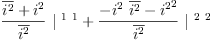
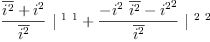

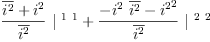

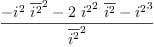

![\label{eq30}\left[ 8, \: 4 \right]](images/1687639146406929369-16.0px.png "\label{eq30}\left[ 8, \: 4 \right]")
![\label{eq31}\left[{\left[ -{\frac{1}{\overline{i^{2}}}}, \: 0, \: 0, \: 1 \right]}\right]](images/6774066325662674012-16.0px.png "\label{eq31}\left[{\left[ -{\frac{1}{\overline{i^{2}}}}, \: 0, \: 0, \: 1 \right]}\right]")
![\label{eq32}\left[{{u^{1, \: 1}}= -{\frac{p_{1}}{\overline{i^{2}}}}}, \:{{u^{1, \: 2}}= 0}, \:{{u^{2, \: 1}}= 0}, \:{{u^{2, \: 2}}={p_{1}}}\right]](images/2707251039667366339-16.0px.png "\label{eq32}\left[{{u^{1, \: 1}}= -{\frac{p_{1}}{\overline{i^{2}}}}}, \:{{u^{1, \: 2}}= 0}, \:{{u^{2, \: 1}}= 0}, \:{{u^{2, \: 2}}={p_{1}}}\right]")

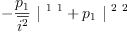

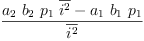
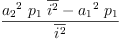



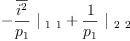


![\label{eq55}\left[ \right]](images/3962816661263452472-16.0px.png "\label{eq55}\left[ \right]")




![\label{eq64}\left[{{i^{2}}= 1}, \:{{p_{1}}= 0}, \:{{p_{2}}= 1}\right]](images/7385841571515306420-16.0px.png "\label{eq64}\left[{{i^{2}}= 1}, \:{{p_{1}}= 0}, \:{{p_{2}}= 1}\right]")
